

Hi hi hi!!!
Welcome to another blog post. Today, I’m going to be discussing the ukulele and my beginner journey attempting to play the instrument. As mentioned in the previous sentence, I am a BEGINNER, so don’t expect anything too complicated out of me.
So, what is the ukulele (or uke)?
By Google Wikipedia definition, it is an instrument that is a member of the lute family. Though the instrument is of Portuguese origin, it was popularized in Hawaii (as you can tell through a quick Google search and mainstream media). It’s made up of four nylon strings and is generally considered easier to play than the guitar because of that.
It looks like this for those who don’t know.
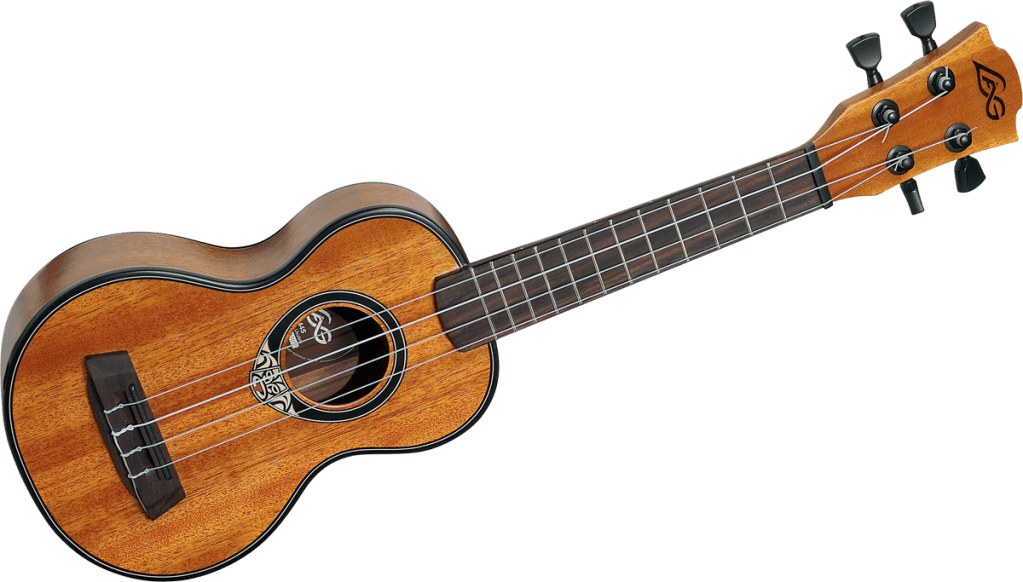
Now, my uke looks similar to that, but way more colorful. It’s a soprano uke, so it’s smaller than a concert or bass ukulele but still has a relaxing sound to it.
It looks like this by the way.

It’s so cute and pretty!!! I got it at the fair and bought it on intentional impulse because at that point, I’d been wanting an instrument to play and this was the perfect opportunity to learn how to play something. Bonus points the uke is one of the easier instruments to start out on.
My uke was slightly less than $50 (I think it was actually $45) and compared to prices I was seeing online, I thought that was the best-case scenario. Plus, I was actually able to inspect the uke before buying it and take the proper precautions to make sure it arrived home in one piece.
It wasn’t until later that I learnt there are different types of ukes. There are four main types of ukes:
- soprano
- concert or alto
- tenor
- baritone
The uke I bought is a soprano uke (if you were wondering).
Playing the ukulele
Now that you’ve learnt more about the uke than you probably wanted to know, let’s get into playing the uke.
While first attempting to play the uke, I learnt that there are right-handed ukes and left-handed ukes. I bought a right-handed uke without knowing which is my playing style. Guess which hand I felt more comfortable playing the uke with?

It’s not that I can’t play with my right hand, I just much prefer my left. Because of this, I may look into getting a left-handed uke in the future, but for now I’ll work with what I have.
Before playing your uke, you have to tune it properly so the notes sound the way they should. You can tune the uke to the specific uke you have (i.e. soprano uke) or you can tune it to a standard uke. There are free tuning apps you can download to do this or you can purchase a tuner on Amazon. Since I’m only a beginner, I figured the free tuning option would be the best bet.
After tuning my uke, I jumped right into learning how to strum the instrument and then eventually learnt some of the most common notes. As of the writing of this post, I know five notes. And since I can barely play one of them, technically I only know four.
The first note I learnt was a C major. It looks something like this:

Imagine the vertical lines as the strings and the horizontal lines as the frets (I think that’s what they’re called, lmao).
To play a C major, you use your ring finger to press down on the string where I put the circle at. Then you strum and it makes a beautiful, light sound.
The next note I learnt was an A minor (hehe They not like us). It looks something like this:
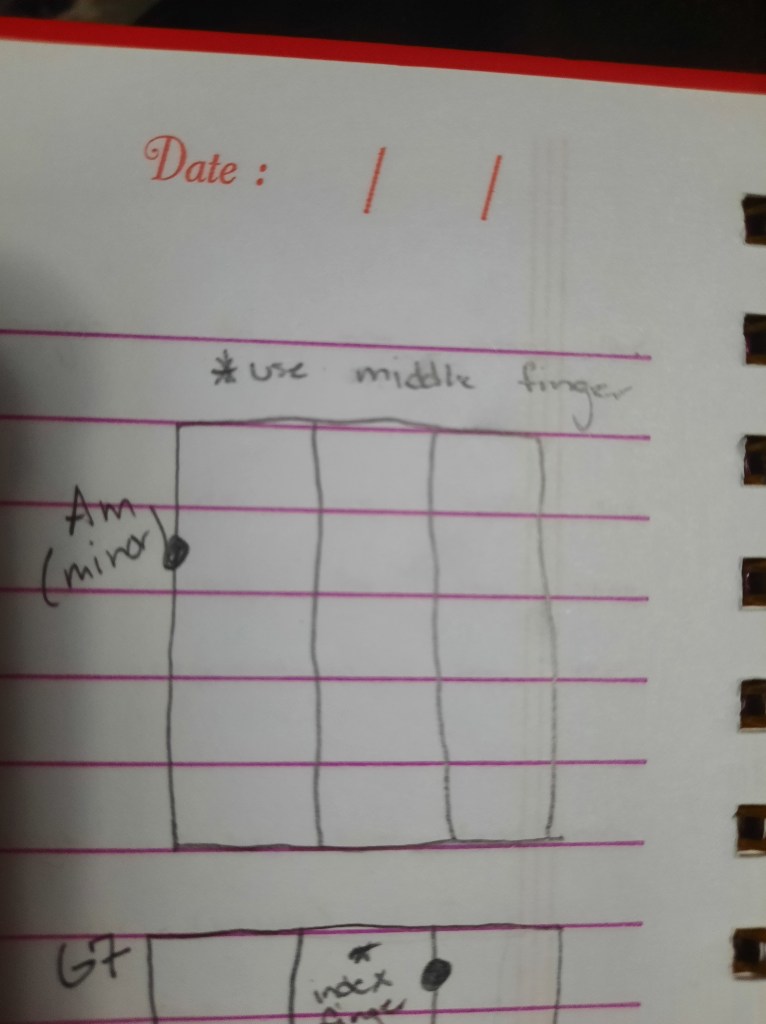
You use your middle finger to play this note. This note is a little deeper than a C major.
The next note I learnt was an F major. Now, this note took some getting used to, but let it never be said that I’m a quitter (at least without reason). It looks something like this:

Notice how there are two dot points on the strings. For the string at the edge, you use your middle finger to press the string and for the 3rd string, you use your index finger.
It feels kinda weird at first, but practice makes it feels more comfortable. This note sounds higher than both the previous two notes and piques your attention a bit more.
The next note I learnt was a G7. This is the note that will be the death of me as it seems no matter how much I practice it, I still can’t get my fingers to press the strings correctly.
It looks something like this:
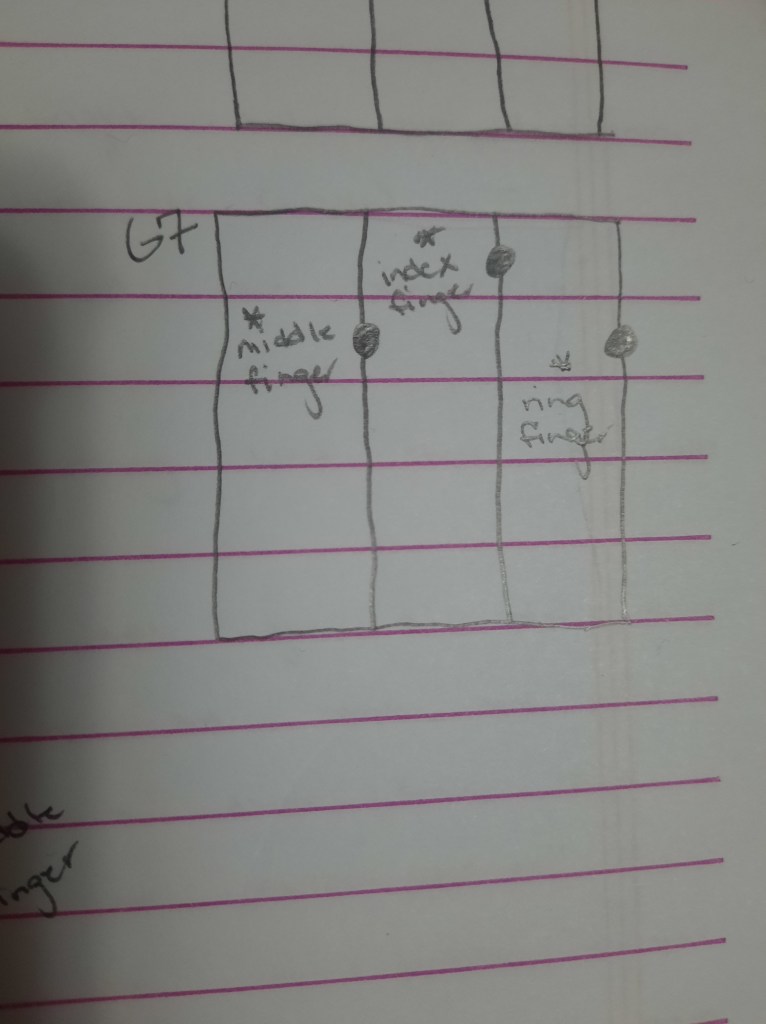
As you can see, there are three fingers for this note. You use your middle finger on the second string, your index finger on the third one, and your ring finger on the last string.
If you’re trying to play it right now, I know it’s difficult. Especially for a beginner. Or, at least it is for me. This note sounds higher than the C major and A minor but slightly deeper than the F major.
The last note I’ve learnt is the G major. This is another note that requires three fingers.
It looks something like this:
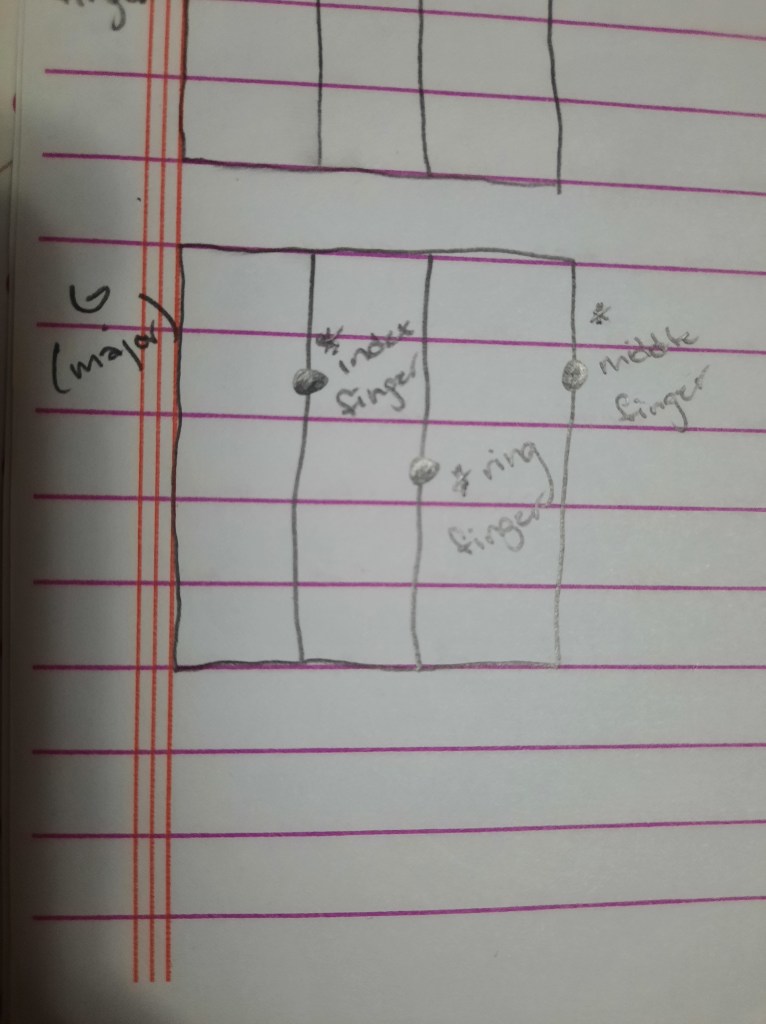
You use your index finger on the second string, your ring finger on the third string and your middle finger on the last string. I would personally place this note as deeper than the G7 and F major but higher than the C major and A minor.
Now, as I’m telling you how these notes sound to me, keep in mind that I’m a beginner and I could very much be playing these notes wrong. As of my skills right now, this is how the notes sound to me and how I organize them in my head.
Truth be told, I could be playing songs on the uke right now if I practiced every day like I’m supposed to. Unfortunately, I am very much an out-of-sight-out-of-mind type person (thanks ADHD) and I also work a full-time job. Factor in the fact that I exercise daily and have other tasks to complete and there’s barely anytime for me to practice.
But that’s not an excuse. If I want to be good at the uke, if I want to truly learn how to play an instrument like nobody’s business, I need to lock in (aka focus) and make the time to practice this instrument the way it’s intended. You can only become great at something if you practice it and I plan to be great at the things I do.
That’s all I have for you guys today. Thank you so much for taking the time out of your day to read my post; feel free to check out my other posts as well (and maybe even subscribe if you feel like it).
Thanks so much and I’ll see you in the next one!!!


 Moon's Creative Corner
Leave a comment